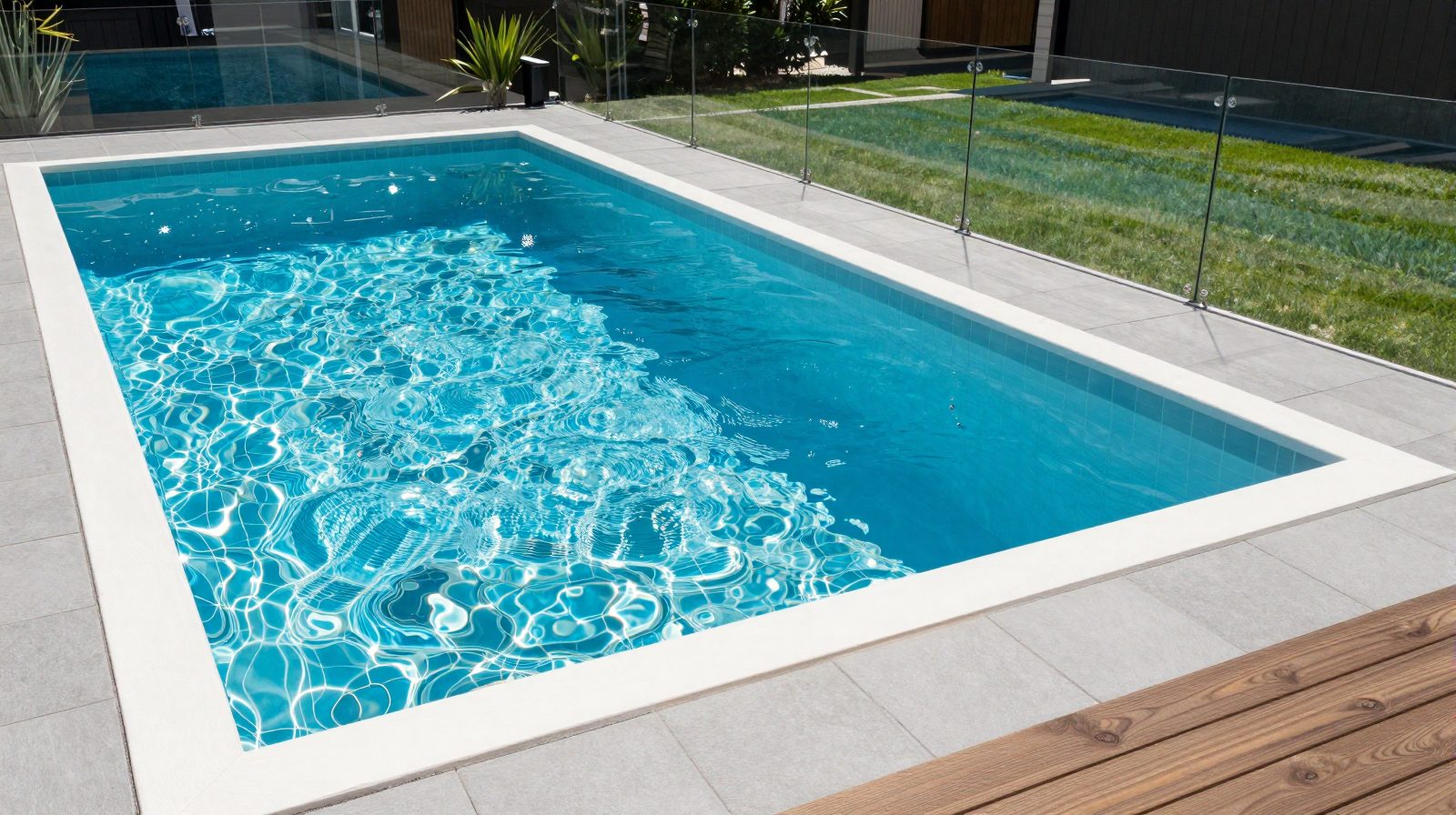
Illustration.
Work out your litres
How the sum works
A pool's volume is its surface area times its average depth. For a rectangle: length × width × average depth, in metres, gives cubic metres; each cubic metre is 1,000 litres. Average depth is the shallow end plus the deep end, divided by two. An 8 by 4 metre pool, 1.0 m deep at one end and 1.8 m at the other, holds 8 × 4 × 1.4 = 44.8 m³, about 44,800 litres.
Round pools use π × radius² for the area; oval and kidney pools are close to an ellipse, π × half the length × half the width. Freeform pools are best measured as a few rectangles added together.

Measure the water, not the shell. Use the length and width at the waterline and the depth from the waterline to the floor, and your doses will be closer.
Common questions
How do I calculate my pool volume in litres?
Multiply length × width × average depth in metres to get cubic metres, then multiply by 1,000. Average depth is (shallow + deep) ÷ 2.
How many cubic metres is my pool?
Length × width × average depth, in metres. A typical 8 × 4 m pool with an average depth of 1.4 m is about 45 m³.
What size pump do I need for a 40,000 litre pool?
Health guidance says the filter should turn over all the water within 6 to 8 hours, so a 40,000 L pool needs a pump and filter that move roughly 5,000 to 6,700 litres an hour through the system. Check pump curves with your installer. More on running your pump.