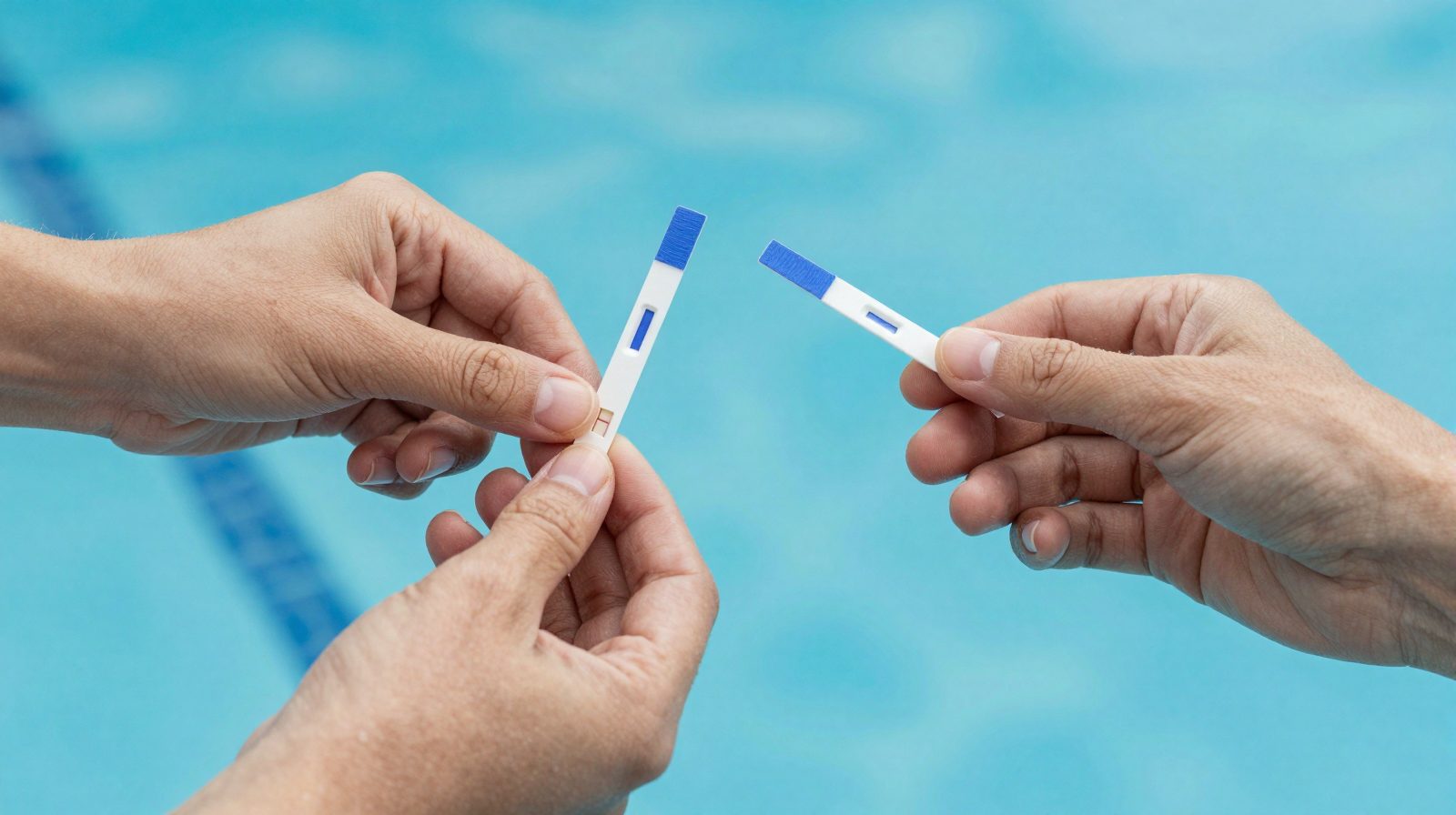
Illustration.
Calculate a dose
Safety. Follow the product label. Add chemicals to water, never water to chemicals. Never mix chlorine and acid. Keep children and pets away and never add chemicals while anyone is in the pool. Wait at least 30 minutes, or longer when the product label requires it; retest and meet its reopening conditions before anyone swims.
How the sum works
1 mg/L is 1 gram per 1,000 litres. So to lift free chlorine by 2 mg/L in a 50,000 L pool you need 2 × 50 = 100 g of chlorine. Liquid pool chlorine is usually sold at about 12.5% available chlorine, which is about 125 g per litre, so 100 g is about 0.8 L. Granular calcium hypochlorite is commonly about 65%, so 100 g of chlorine is about 154 g of granules. Check the strength on your product's label and type it in.
What to aim for
HealthyWA (the WA Department of Health) says an outdoor pool with stabiliser should hold free chlorine of at least 2 mg/L, or 3 mg/L when the water is above 26°C, with pH between 7.2 and 7.8 (7.5 ideal) and stabiliser between 30 and 50 mg/L. Indoor and unstabilised pools need at least 1 mg/L (2 above 26°C).

Add liquid chlorine in the evening with the pump running. Sunlight breaks chlorine down fast, so a dose at dusk lasts longer.
Common questions
How much liquid chlorine do I add to my pool?
About 80 mL of 12.5% liquid chlorine raises 10,000 litres by 1 mg/L. Multiply by your litres (in tens of thousands) and by how many mg/L you need to rise.
How much chlorine for a 50,000 litre pool?
To lift free chlorine by 1 mg/L, about 0.4 L of 12.5% liquid chlorine or about 77 g of 65% granular chlorine.
Can I swim after adding chlorine?
Health guidance says to wait at least 30 minutes for chemicals to dissolve and never to add chemicals while anyone is in the water. Retest before swimming.