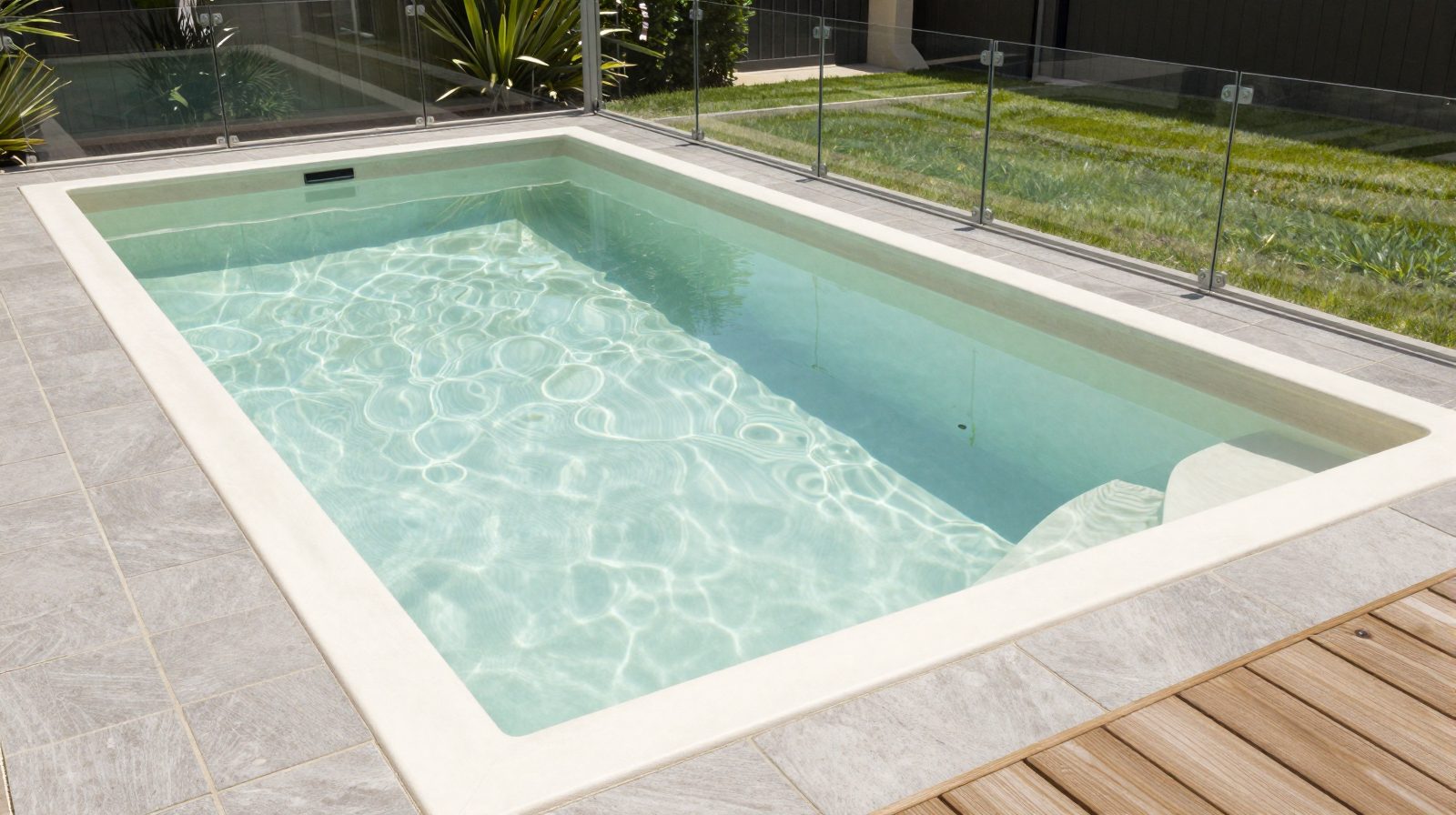
Illustration: the same pool, cloudy.
The usual causes
- Free chlorine is too low. Heavy use, hot weather or rain uses it up.
Fix: test and bring free chlorine up to the healthy level (at least 2 mg/L in a stabilised outdoor pool, 3 above 26°C). Calculate how much.
- pH is too high. Above 7.8, chlorine works poorly and calcium can come out of the water as a haze.
Fix: bring pH back to 7.2 to 7.8. How.
- The filter is dirty or not running long enough. Health guidance says the filter should turn over all the water in 6 to 8 hours.
Fix: backwash a sand or glass filter, or hose out a cartridge, and run the pump longer until clear. Filters · Pump hours.
- The chlorinator cannot keep up. HealthyWA notes a salt pool can turn milky if it is overused and the chlorinator cannot make enough chlorine.
Fix: add chlorine by hand to catch up and check the salt cell. Salt chlorinators.
Step by step
- Test free chlorine and pH.
- Fix pH first, then chlorine.
- Clean the filter and run the pump continuously.
- Brush the walls and floor.
- Retest the next day. Most cloudy pools clear within a day or two once the chlorine and filter are right; a pool that stays cloudy may need a clarifier or flocculant, used as the label says.
Safety. Follow the product label. Add chemicals to water, never water to chemicals. Never mix chlorine and acid. Keep children and pets away and never add chemicals while anyone is in the pool. Wait at least 30 minutes, or longer when the product label requires it; retest and meet its reopening conditions before anyone swims.

If it went cloudy straight after you shocked it, give it 24 hours with the filter running before adding anything else. Shocking can leave a milky haze that the filter clears by itself.
Common questions
How do I clear cloudy pool water?
Test and fix pH, raise free chlorine, clean the filter and run the pump until the water clears, usually a day or two.
Does shock clear a cloudy pool?
Shocking (a large chlorine dose) clears cloudiness caused by low chlorine or organic waste, once the filter catches up. It will not fix a dirty filter or high pH.
Should I add chlorine to a cloudy pool?
Test first. If free chlorine is low, yes. If chlorine is fine, look at pH and the filter.
Is it safe to swim in cloudy pool water?
Not until it is clear. Cloudy water usually means the chlorine is losing and you cannot see a swimmer on the bottom. Health guidance says a milky pool cannot be used safely until the water is clear.
Does baking soda help with a cloudy pool?
Baking soda (sodium bicarbonate) raises total alkalinity. It only helps if low alkalinity is part of the cause; test first.